
Archive

Categories
Coaching

Responsible Communication

For many organizations, collaboration is a key element. But just because teams are collaborating more than ever doesn’t mean they’re doing it effectively – and the main culprit is usually communication. In an era where we’re balancing in-person, hybrid and remote workers, effective communication is more important than ever. But it takes work and it often means being candid.

When people hear the words “candid conversation,” it can often be accompanied with feelings of anxiety and a pit in their stomach. But being “candid” doesn’t have to be synonymous with being disrespectful or unkind. In fact, candid communication used in the right way is kind – it builds greater trust, transparency and opens the door to more constructive conversations about tough issues.

So often, managers (particularly new ones) and team members are focused on being “nice” and they’re afraid to speak up when problems arise. Or they sugar coat communication so much that it loses any effectiveness. There are ways to be both candid and respectful. Here are a few tips to keep in mind:

  • Learn how to provide feedback: We touched on this briefly in our last article, but learning how to give constructive feedback is so vital. When challenges arise, leaders can use both kindness and candor at the same time. The key is self-awareness and training. It’s important to understand your own feelings about having difficult conversations, especially if you’ve had experiences when feedback was given in a hurtful way or if you’re uncomfortable with conflict.
  • Build trust through communication: When you build relationships that include mutual trust, you and your team will be more comfortable bringing up issues and being yourselves. How do you build that kind of relationship? Actually, the first step is being more candid! A leader who provides honest and transparent communication is more likely to gain the trust of their team than someone with a facade of “niceness”.
  • Make sure you lead by example: Again, it all comes from the top. Show that you’re open to feedback (ask for it!) and others will do the same. Provide opportunities for team members to bring up issues without having to be afraid of repercussions and reward those who do it respectfully. Not every candid remark will be helpful, but nurturing a culture of candor and kindness has more benefits than downsides.

Remember that approaching difficult conversations with kindness allows you to be both objective and empathetic – and these are the basic requirements for candidness.

Effective communication is the backbone of any organization, yet many leaders struggle when it comes to having honest, candid conversations with team members. Working with a coach, like Leah M Joppy and Associations, can help managers at any stage in their career take a closer look at their communication style, areas for improvement and tactics to provide feedback and solve problems in a direct and respectful way. Your employees will thank you for it!

Call us at 301-670-0051 or email us at leah@lmja.com to learn more.


Share
Categories
Coaching

Building A Creative Problem-Solving Culture

It’s inevitable. Problems are going to happen in the workplace. It’s how leaders and team members approach them that makes all the difference. And trying to solve new problems using old solutions isn’t the answer. That’s why creative problem solving (CPS) is a such a vital skill to prioritize and develop. It fosters innovation, encourages brainstorming and approaches issues from a fresh perspective. In our last article, we looked at many of the reasons why CPS is a benefit for any organization. But how do leaders and teams get started if this is a relatively new concept and way of approaching problems?

The CPS process can be broken down into 7 steps:

  1. Identify the goal: Before solving a problem, you need to understand the problem. Take some time to analyze the conflict and clear up any confusion. Did you misunderstand some details or overlook something? Clarity is key.
  2. Gather data. Once you know what the problem is, you need to learn all about it. Gather all the information you can to gain a better understanding of the issue and to solve it. For example, who is involved in solving the issue? Who does it affect?
  1. Ask challenging questions. After you’ve gathered details, turn the problem into a question. Be sure to phrase the question in a way that encourages suggestions and ideas. Questions should be short, concise and only focus on a single issue. Trying to tackle too much only leads to frustration and feeling overwhelmed.
  1. Explore ideas. Now the brainstorming begins and the creativity really starts to flow as you create possible ideas and solutions. With so many ideas being thrown around, it’s crucial that you write each one down—even they seem a little stupid! Trying to sort out bad ideas from good ones during this step can squash creativity.
  1. Come up with solutions. Evaluating each idea will help you zero in on the best solution and weed out the less effective ideas. See if the possible solution actually solves the problem and if you can implement it successfully. If it doesn’t resolve the issue, move on to the next idea.
  1. Create an action plan. Now that you have a solution, it’s time to create an action plan outlining steps for implementation. Think about what resources you’ll need, how long it will take and document everything clearly. Once you create the plan, communicate it to the rest of the team so everyone is on the same page.
  1. Take action. Now that your plan is created and your team on board, it’s time to implement your solution and resolve the problem. Then, take a step back, look at what worked, what could have been done better and document ideas for the next time.

Dealing with problems in the workplace is a fact of life, yet so many us are conflict-averse. It’s human nature! But learning the CPS process can make a big difference in how both leaders and team members face hurdles and come out stronger on the other side. It takes training to build these skills and that’s where Leah M Joppy and Associates can help. We work with both leaders and team members to learn how to approach problem solving in a fresh, creative way that builds trust, innovation and a new perspective. It’s an investment that pays off in a big way for your organization.

Ready to learn more? Contact us at 301-670-0051 or email us at leah@lmja.com to learn more.

Share
Categories
Coaching

Recognizing A Strong Leader

If someone asked you, “what are the critical components of strong leadership”, what answer comes to mind? Maybe good listening skills or excellent communication would top the list. Or perhaps the ability to delegate and not micromanage. While all of those answers are spot-on, you may be surprised by one crucial component that’s often overlooked: self-reflection.

If you’re in a leadership role, when was the last time you made an effort to focus on self-reflection? Or have you ever really done it or even figured out what it means? Self-reflection is taking some time to think about your thoughts, behavior, motivation and actions. The concept seems simple, but it can be surprisingly difficult to do. We’re always moving on to the next project, meeting or crisis without pausing to reflect on what happened earlier that day or that week. On the flipside, self-reflection is NOT about beating yourself up and getting stuck in the past. We can’t turn back time or erase a negative outcome, but we can learn from those experiences and change our behavior or leadership tactics moving forward.

So, why is self-reflection a key practice for leaders? It’s all about the 3 A’s: Awareness, Adaptability and Action. Let’s take a closer look:

  • Awareness: Self-reflection helps leaders become aware of their strengths and weaknesses. That kind of awareness helps them better understand how they lead, teaches them to capitalize on their strengths and work on improving weaknesses.
  • Adaptability: The practice of self-reflection enables leaders to gain insights from past projects, interactions and team dynamics. They’re better able to adapt, grow and respond to changes, conflicts and whatever else is thrown at them.
  • Action: By practicing self-reflection, leaders learn to look at situations from a neutral perspective and set their own egos aside. This helps them see the big picture and take action where needed.

A consistent self-reflection practice pays off in so many ways for leaders and helps them:

  • Set priorities and make better decisions
  • Learn to use feedback for growth rather than taking it personally
  • Maintain better relationships
  • Communicate effectively by understanding how they come across to others
  • Create a more honest and productive work environment

Taking the time to reflect has big benefits for both leaders and organizations. Yet many don’t recognize the value or know how to put it into action. That’s where working with a coach, like Leah M Joppy and Associates, can help leaders build a regular, ongoing self-reflection process. Leaders will learn how to ask effective types of reflection questions, receive personalized feedback and help set and achieve their goals. Ready to learn more? Call us at 301-670-0051 or email us at leah@lmja.com to learn more.
Share
Categories
Coaching

The Bests Ways To Practice Self-Reflection

For such a useful practice, the self-reflection process is not something we know how to do intuitively. It’s not something we learn about in school and it isn’t part of most job training. Our work environments tend to focus on what to do next or how to do more. We’re shaped by “always moving forward” work cultures and we believe there’s no time to pause and reflect. Most of us don’t learn about the power of self-reflection until someone else, often a coach or mentor, guides us through the process.

Self-reflection enables leaders to identify their strengths, weaknesses and areas for improvement. But how do you begin a self-reflection practice if it’s not something that you typically take the time to do? Here are a few suggestions:

Reflect regularly

Schedule 10 to 20 minutes a week for self-reflection. This should be blocked out in your calendar, so it’s a set time for you to quietly think and self-reflection becomes a regular habit. A quiet and calm place without distractions is ideal. For some, leaving the office environment helps clear the mind. Others may choose to arrive at the office 30 minutes earlier when it’s quiet, to reflect on the day or week ahead.

Develop a structure for reflection

Self-reflection can be overwhelming to begin with and particularly without a set focus. You may want to start with a single question or topic, such as the following areas:

  • Week in review: What went well? What did you learn? What could you do differently?
  • Highlights: What did you do well as a leader this day and/or week?
  • Leadership: What type of leader do you want to be? Which leaders do you look up to? How does your team view you as a leader?
  • Values: What are your core values? Do they align with your organization’s values?
  • Team: What type of leader does your team need? Are there ways you could better meet their needs?
  • Goals: What are the current goals of your organization? What needs to be done and are you on track? What do you need to do as a leader to meet these goals?

Write down your thoughts

Writing down thoughts and ideas down during self-reflection frees up space in your mind and gives you the opportunity to organize your thoughts. Plus, having a record of your self-reflective thoughts means that you can check back regularly and see your progress.

Encourage your team members to practice self-reflection

While self-reflection is important for leaders, your team can also find a lot of value in it. Encourage your team to regularly reflect on their own performance, as well as yours and make them feel comfortable sharing their insights with you.

Self-reflection is a humbling, but powerful technique that helps leaders (and team members) improve their performance. But it can be a tough process that makes you take an

honest look at yourself: your strengths, your weaknesses, areas for improvement and how you should work to grow and develop. Leah M Joppy and Associates is ready to help you make self-reflection an important component of your leadership process. We can help you set goals and provide support and accountability. Contact us at 301-670-0051 or email us at leah@lmja.com to learn more.

Share
Categories
Coaching

Finding Ways To Make Back-To-Office Work More Palatable

In the wake of the COVID-19 pandemic, the dynamics of the workplace underwent a major shift. So many of us became used to the flexibility of working from home. Our routines shifted, we started saving hours a week in commuting time and many of us found a work/life balance. Now, it seems like we’re poised to undergo another major shift: return-to-office (RTO) mandates. And workers’ unhappiness with this “new normal” has been deafening.

Here’s something startling to consider: according to the Federal Reserve’s Survey of Household Economics and Decisionmaking (SHED), the dissatisfaction of shifting from a flexible work model to a traditional one has the same effect on employee satisfaction as a pay cut of up to 3%. That’s pretty sobering and something that can’t be ignored. We looked at other discouraging numbers in our last article. If you’re a leader within your department, you’re probably throwing up your hands and wondering what you can do. You can’t ignore RTO mandates, but you also can’t disregard your team members’ feelings and preferences. Here are a few things to consider:

Get employee buy-in
There are valid reasons to request that employees come back to the office, but everything needs to be transparent and equitable. For an RTO plan to be successful, leaders need to make it clear why in-person work will bring better value to team members. Give them a reason to be excited about in-person work. If your team isn’t on board, your department will be dealing with retention issues.

Build connection points
One of the main reasons people come into the office is to see their colleagues. One of the main reasons they don’t come in is because they don’t end up seeing them and the office is nearly empty. When employees are planning their hybrid work schedule, they should know in advance who else will be in the office through a workplace management system. Then, once they’re in-office, there should be spaces to make collaborating with others as simple and stress-free as possible.

Look into subsidizing costs
Commuting, childcare and pet costs are all top reasons why many workers are hesitant to return to the office. So, it’s no surprise that they’re looking for support from management to help them offset these costs. Workers don’t want to feel like they have to pay to come into the office. Does your department have the ability to subsidize some of the costs of working in-person? It could make a major difference to many of your team members.

Listen to employee feedback
Finally, your team members are your greatest asset. It’s important that leaders take the time to listen to their concerns and feedback, before and after the RTO. Making adjustments based on feedback can make a big impact when it comes to putting together an RTO strategy that puts your employees first.

Navigating RTO mandates can be challenging for even the most seasoned leaders. Leah M Joppy and Associates can work with your organization to face the hurdles and develop RTO strategies for both you and your team members. Contact us at 301-670-0051 or email us at leah@lmja.com to learn more.

Share
Categories
Coaching

Why Some Managers Are Resistant To Work Schedule Flexibility

For many organizations, work schedule flexibility is a new part of their compensation package. It’s a powerful tool in terms of employee engagement, retention and recruiting. Remote and flexible schedules have shown to not only provide employees with higher job satisfaction, but better health, less absenteeism, increased work-life balance and less stress. This is all well and good for workers, but what do managers really think about remote work? While many understand the appeal and benefits, it’s still difficult to embrace change and work through the challenges of managing a remote and/or hybrid team.

Here’s a look at 7 reasons why managers may be resistant to remote work:

  • Lack of accountability and supervision: Sure, some team members work well (and in some cases better) working remotely. Then there are those that struggle with time management, distractions and other challenges. Managers may feel that it’s more challenging to supervise employees and keep them accountable when they’re not physically present in the office.
  • Loss of collaboration: Face-to-face interaction is often believed to foster a more cohesive work environment. Some managers worry that remote work can make it harder for team members to truly feel like a team. This is of particular concern for new team members and younger workers who are just starting out in their career.
  • Lack of company culture: Strong in-office culture can be a key component for an organization’s retention and recruitment. Managers may worry that remote work could be a hinderance towards building this culture.
  • Increase in security concerns: There may be concerns about the security of data when employees are working outside the office.
  • Decrease in productivity: Some managers may feel that team members are more productive in a controlled office environment. Working from home can potentially have more distractions and chances to break from a traditional work schedule.
  • Concerns about equity: In some settings, not all roles can be performed remotely or on a hybrid schedule. Allowing some employees to work from home might create perceived (or actual) inequities among team members.
  • Holding onto a traditional mindset: Some managers may still have a traditional view of work that involves all team members being present at a common workplace. Change is hard and personal experiences and beliefs take time to overcome, particularly when it comes to management practices.

As we discussed last month, an annual government-wide survey conducted by the Office of Personnel Management found that more than two-thirds of federal employees are still teleworking at least occasionally. Remote and hybrid work isn’t going anywhere, but neither are the management challenges if your organization doesn’t face them head on. Leah M Joppy and Associates can help you figure out your primary challenges and work with you and your team to make remote/hybrid working a more efficient, productive and collaborative experience!

Call us at 301-670-0051 or email us at leah@lmja.com to learn more.

 

Share
Categories
Coaching

Why Some Employees Find Remote Work To Be A Challenge

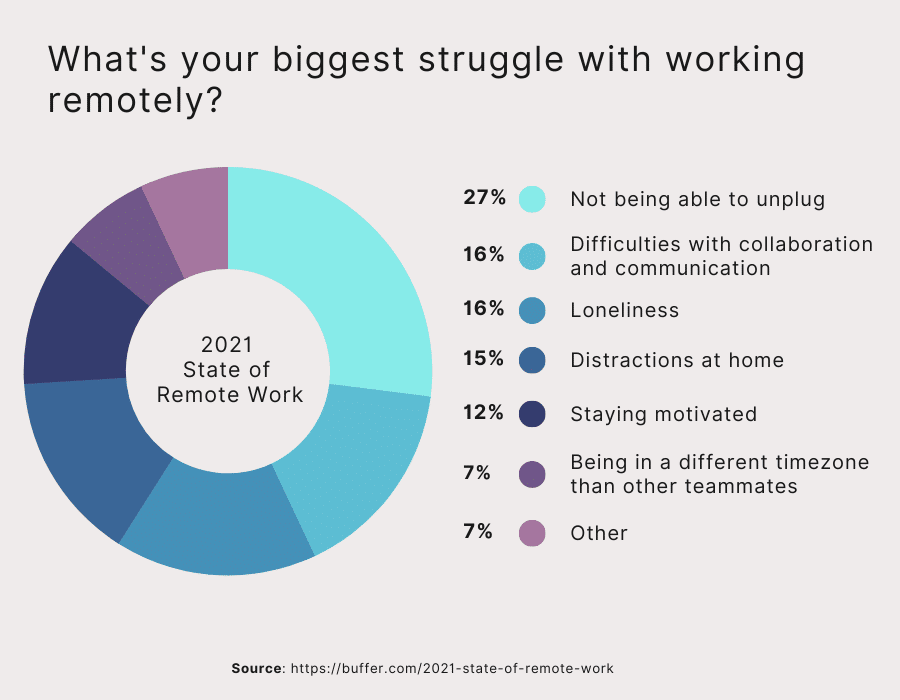
When we think of remote work, many of us think of meetings in our sweatpants, the ability to schedule appointments when we want and not having to sit in traffic for hours. For many, a remote or hybrid schedule is like a dream come true. We’ve looked at the variety of benefits in past articles, among them: work/life balance, increase in productivity, no commute, increased flexibility and autonomy and so much more. And we’ve looked at why offering a remote and/or hybrid schedule is an incredibly effective recruiting and retention tool. But even with all the positives, remote work can present a whole new set of challenges for some employees. Let’s take a look at some of the top 5 remote work complaints:

Con #1: Social isolation

This is probably the number one complaint that employees have about remote work, particularly new workers and young workers who are new in their career. It may be challenging to build strong relationships with colleagues without face-to-face communication, resulting in a sense of disconnection from the team. Social events like happy hours that were once spur of the moment and easy to plan, now take more effort and can end up on the backburner.

Con #2: Work-life boundaries are blurred

While some feel one of the biggest benefits of remote work is work/life balance, others have difficulty unplugging from the office and feeling like they’re always “on call”. It can be difficult to disconnect from work and take breaks when workspace is also a private space. This lack of separation can negatively impact mental well-being if not managed effectively and can lead to burnout.

Con #3: Communication and collaboration are limited

Zoom meetings are all well and good, but some aspects of face-to-face interaction can’t be done remotely. Remote work can make it challenging to build trust through in-person interactions. Some team members may also feel like their access to mentorship, networking and senior leadership opportunities are more limited.

Con #4: Risk of miscommunication

Remote work often involves written communication, which can sometimes lead to misunderstandings or misinterpretations. It may be challenging for remote workers to resolve conflicts effectively without the benefit of immediate in-person conversations.

Con #5: Lack of focus and distractions

While the typical distractions of the workplace may be eliminated, remote work introduces a new set of distractions at home. It’s easy to be distracted from work tasks by household chores, family members or other personal issues. Some workers may not have the space to exclusively dedicate to a home workplace and have to work in busier areas.

Each of us has a unique personality and work style. For every person who enjoys the solitude of working remotely and the freedom that it provides, there’s another who thrives on human interaction or craves the routine and structure of going into the office. That’s why management plays such an important role in implementing a strategic remote/hybrid work strategy and communicating it effectively with team members. Leah M Joppy and Associates is ready to help you reduce the cons of remote work and ensure that team members feel supported and engaged.

Contact us at 301-670-0051 or email us at leah@lmja.com to learn more and get started.

Share
Categories
Coaching

How To Work With The Digital Generation

Did you know that Gen Z, the group born between 1997-2012, represents 32% of the global population and will account for 27% of the workforce by 2025? These “digital natives” have been shaped by social media, the COVID-19 pandemic and an uncertain financial landscape. Their unprecedented access to information and communication has shaped their behaviors, expectations, and perspectives. And, as we saw in our article above, it has also shaped the way they approach career advice and the workplace.

For many employers, Gen Z can be a tough group to figure out. What are they looking for in a career? If they’re hired, how can organizations make sure they don’t jump ship quickly? Gen Z tends to be socially conscious and values diversity, inclusion and sustainability. They seek purpose and meaning in their careers, placing a strong emphasis on personal growth, continuous learning and making a positive impact.

Last month, we looked at a few of the top things younger job seekers are looking for in the workplace. Here, we’ll look at 3 proven ways to keep them once they’re in the office:

  • Assign projects that align with their passions and values: Taking the time to understand the individual passions and values of your Gen Z employees will help ignite their motivation. When assigning projects, consider their interests and align them with their core values.
  • Provide regular feedback and progress updates: Gen Z employees want to know how they’re performing. It’s important to provide regular, specific feedback on their work and progress, highlighting their strengths and areas for improvement. Also, providing progress updates will give them a clear understanding of how their work contributes to the larger goals of the organization.
  • Give them autonomy and ownership: Micromanaging Gen Z is the first step towards showing them the door. These younger employees thrive when given autonomy and will be empowered if they can take the lead on projects and make decisions. It shows that you value their input and believe in their capabilities – and it goes a long way with this generation.

Gen Z also prefers consuming information in bite-sized, easily digestible formats. Offering “microlearning” opportunities is a great way to cater to this preference. Examples include: breaking down training materials, onboarding and development resources into shorter modules or interactive formats.

As you look at your hiring strategies for 2024, how are you approaching attracting and retaining Gen Z employees? It may not be something you’ve thought a lot about and you may feel that the same old tactics will be “good enough”. Not taking the time to get to know the wants and needs of Gen Z can really put your organization at a disadvantage. Leah M Joppy and Associates is ready to help you hone your Gen Z recruitment strategy and will look at your current workplace environment, culture and more to make suggestions as to how you can attract younger team members. Call us at 301-670-0051 or email us at leah@lmja.com to learn more.

Share
Categories
Coaching

Guidelines Designed To Help Your Organization Enhance Collaboration

When it comes to collaborating with your own team, it can often seem like a no-brainer. You know everyone’s role and communication style, your meetings are fairly predictable and everything seems like it’s just humming along. But when you add another department or organization into the mix, it can really throw you for a loop. The dynamics are different, you don’t know everyone’s work style and communication can seem like a struggle. It can test both your team members and your leadership skills. However, if you build the foundation for strong cross department collaboration at the beginning of a project, it can make all the difference.

In our last article, we looked at the benefits of effective collaboration among departments, as well as the biggest offenders that lead to communication breakdown. What are some ways to enhance collaboration and avoid any pitfalls? Here’s a look at the top 6:

  • Make sure everyone understands the overall objective and their role in it: We touched on this in our last article. If team members don’t understand their role and the common goal they’re working towards, it can really derail a project. Clear communication from the top is so important and it starts with strong leadership and transparency.
  • Encourage consistent communication and feedback: Communication comes from the top. Leaders must create clear systems to make this happen and build a culture where team members feel comfortable providing feedback.
  • Create a culture of collaboration and community: Casual get-togethers and other team-building opportunities are an important part of the collaboration process. More and more teams and departments are working remotely or on a hybrid schedule, adding another layer of challenges. Leading teams that are both remote and in-person work best when remote workers are encouraged to see and interact with the larger department teams.
  • Get to know the way other departments work: Team members can’t collaborate effectively with other departments if they don’t understand what they do and their work style. Make sure your team members aren’t working in a bubble and have opportunities to job shadow if needed, get involved in other departments’ processes, etc.
  • Share technology and information: Make sure each team has access to the same types of data, people, tools, etc. This keeps the lines of communication open and makes it easy for teams to approach one another if they have access to the same information.
  • Celebrate successes: Taking time out to recognize team members’ contributions goes a long way towards building morale. And it doesn’t have to be at the end of the project. Celebrating milestones throughout the process is a great way to keep everyone motivated.

Collaborating across departments or organizations can seem like an uphill battle, but with the right coach by your side, it doesn’t have to be. Leah M Joppy and Associates can work with you to improve your collaboration efforts and ensure that there’s transparent communication, efficient processes and strong leadership at the helm. When collaborative efforts are working effectively, team members feel that their voice is valued, they’re more engaged, more receptive to ideas and more likely to do their best work. And who doesn’t want that?

Are you ready to learn more? Call us at 301-670-0051 or email us at leah@lmja.com.

Share
Categories
Coaching

When It’s Challenging To Recruit, Consider The Assets Of The Department

It’s no secret that it’s getting more and more challenging to recruit, hire and retain employees. You may wonder how you can compete, particularly when other organizations may be willing to offer higher compensation. However, salary isn’t the only factor that job seekers look at when searching for a new position. So many other variables come into play, like a department’s  culture, flexibility and an emphasis on well-being. The key to making your open positions stand out is to tell your unique story in a clear and effective way through a strong employee value proposition.

What is an employee value proposition (EVP)? Simply put, an EVP communicates the value an employer provides to its employees. Some of these assets may be beyond your control, but others can be emphasized by good leadership and professionalism. The most compelling EVPs include tangible assets, like benefits packages, and intangible values such as professional growth opportunities. The more benefits of working for your organization that you provide, the stronger your EVP is when hiring new team members.

No matter the state of the job market, an effective EVP is a vital tool for talent acquisition. It encompasses the assets you offer as an employer to attract new talent and retain your best employees. Here’s a sample of three sections every good EVP should have:

  • Benefits and Perks: According to a Glassdoor survey, 80% of employees value stronger benefits packages over pay increases. Employee benefits are an important part of a good EVP and you should be clear about what you offer. Here’s a sample of what you can include:
    • Health insurance policy
    • Childcare
    • Sick leave
    • Parental leave
    • Paid vacation
    • Retirement plan
  • Career Development Opportunities: Providing employees with the opportunity to learn new skills shows them you’re invested in their success. Career development options could include the following:
    • On-site training opportunities. We can help reinforce training for your group!
    • Tuition assistance.
    • Coaching opportunities. LMJA also offers coaching to groups or individuals.
    • Certification programs.
  • Organizational Culture: Unlike the last two examples, an organization’s culture isn’t tangible, but that doesn’t make it any less important. In fact, cultural fit is key when attracting and retaining employees. LMJA and Associates is particularly helpful in developing and maintaining an attractive culture. Here are some ways to showcase your organization’s culture:
    • Hybrid and remote work opportunities.
    • Flexible hours. Can a new employee work around hours that fit his/her schedule more easily?
    • Teamwork values. How effective are your teams? True teamwork increases work satisfaction. We can help with quality team management.
    • Diversity and inclusion statements. The value of diversity has increased in the last few years. LMJA can help here too.
    • Management style. LMJA has several courses aimed at building exceptional leadership skills.
    • Well-being perks.

With available jobs seemingly outpacing the number of candidates, it’s more important than ever for organizations to attract and retain talent. That’s why it’s vital for organizations to develop a compelling EVP and then effectively communicate it both internally and externally. It can seem like a daunting task, but Leah M Joppy and Associates can help you create an EVP and add various strengths throughout the department. Through these efforts, you have the ability to tell your organization’s unique story and why potential new hires should work for you! Contact us at 301-670-0051 or email us at leah@lmja.com to learn more and get started.

Share

How Can We Help?

Leah M. Joppy & Associates

Derwood, MD 20855