Archive

Categories
Coaching

The Bests Ways To Practice Self-Reflection

For such a useful practice, the self-reflection process is not something we know how to do intuitively. It’s not something we learn about in school and it isn’t part of most job training. Our work environments tend to focus on what to do next or how to do more. We’re shaped by “always moving forward” work cultures and we believe there’s no time to pause and reflect. Most of us don’t learn about the power of self-reflection until someone else, often a coach or mentor, guides us through the process.

Self-reflection enables leaders to identify their strengths, weaknesses and areas for improvement. But how do you begin a self-reflection practice if it’s not something that you typically take the time to do? Here are a few suggestions:

Reflect regularly

Schedule 10 to 20 minutes a week for self-reflection. This should be blocked out in your calendar, so it’s a set time for you to quietly think and self-reflection becomes a regular habit. A quiet and calm place without distractions is ideal. For some, leaving the office environment helps clear the mind. Others may choose to arrive at the office 30 minutes earlier when it’s quiet, to reflect on the day or week ahead.

Develop a structure for reflection

Self-reflection can be overwhelming to begin with and particularly without a set focus. You may want to start with a single question or topic, such as the following areas:

  • Week in review: What went well? What did you learn? What could you do differently?
  • Highlights: What did you do well as a leader this day and/or week?
  • Leadership: What type of leader do you want to be? Which leaders do you look up to? How does your team view you as a leader?
  • Values: What are your core values? Do they align with your organization’s values?
  • Team: What type of leader does your team need? Are there ways you could better meet their needs?
  • Goals: What are the current goals of your organization? What needs to be done and are you on track? What do you need to do as a leader to meet these goals?

Write down your thoughts

Writing down thoughts and ideas down during self-reflection frees up space in your mind and gives you the opportunity to organize your thoughts. Plus, having a record of your self-reflective thoughts means that you can check back regularly and see your progress.

Encourage your team members to practice self-reflection

While self-reflection is important for leaders, your team can also find a lot of value in it. Encourage your team to regularly reflect on their own performance, as well as yours and make them feel comfortable sharing their insights with you.

Self-reflection is a humbling, but powerful technique that helps leaders (and team members) improve their performance. But it can be a tough process that makes you take an

honest look at yourself: your strengths, your weaknesses, areas for improvement and how you should work to grow and develop. Leah M Joppy and Associates is ready to help you make self-reflection an important component of your leadership process. We can help you set goals and provide support and accountability. Contact us at 301-670-0051 or email us at leah@lmja.com to learn more.

Share
Categories
Uncategorized

The Resistance To Returning To The Office

A few years ago, it seemed like remote work was poised to become the norm, but fast forward to 2024 and it’s quickly becoming a sign of the past. Despite overwhelming enthusiasm and support for telework from workers, the trend is shifting and return-to-office (RTO) mandates are becoming more and more prevalent. In May, U.S. Senators Joe Manchin (I-WV) and Mitt Romney (R-UT) introduced the bipartisan Back to Work Act of 2024 to bring employees of federal agencies back to in-person work. This legislation would limit telework to no more than 40% of days within an employee’s pay period and require agencies to report to Congress on the productivity of its telework activities.

Just like private companies whose workers threatened to leave their positions before RTO mandates, there is now similar data from government agencies. Here’s a look at a few:

• An Environmental Protection Agency survey reveals 65.9% of employees indicated they would consider leaving the agency if telework and remote work opportunities were diminished. Additionally, 80% of respondents anticipated experiencing “personal hardships” if telework were reduced.
• At the National Science Foundation (NSF), a survey revealed that 42% of respondents feel that being required to work in the office four days per pay period would significantly affect them. In addition, 27% of NSF employees view RTO expectations as “unworkable” and said they would consider finding new employment or retiring.

So, why are workers so dead set against returning to the office? Here are the most common objections:
• Commuting: The time, energy, cost and stress that workers face before even stepping into the office is one of the biggest deterrents. Some people even moved during the pandemic to get out of the city and into a larger space. This means even more time spent on commuting.
• Lost productivity in the office: People learned how to be more productive working from home and the experience shined a light on some of the inefficiencies of being in the office.
• Childcare and pet costs: The pandemic really highlighted the struggles of maintaining a healthy work-life balance, as well as the cost of spending so much time in the office. So, it’s no surprise that childcare costs and having to leave pets at home were top reasons keeping employees out of the office.
• Unenjoyable office environment: Noise levels will always be one of the reasons people may not want to work in the office, but workers also want to know when their colleagues are going in to work so they can avoid ending up in an empty office. Coordinating that overlap has proved challenging for many organizations.

How is your agency handling return-to-office mandates? Most importantly, how are your team members handling it? Like many leaders, you probably have concerns about recruitment and retention. It’s a challenging situation that can make you feel like you’re powerless. Leah M Joppy and Associates is ready to work with you to face the hurdles and develop RTO strategies for both you and your team members. Each department is different and faces a unique set of challenges. We’ll learn about yours and help you come up with effective solutions.

Call us at 301-670-0051 or email us at leah@lmja.com to learn more.

Share
Categories
Coaching

Finding Ways To Make Back-To-Office Work More Palatable

In the wake of the COVID-19 pandemic, the dynamics of the workplace underwent a major shift. So many of us became used to the flexibility of working from home. Our routines shifted, we started saving hours a week in commuting time and many of us found a work/life balance. Now, it seems like we’re poised to undergo another major shift: return-to-office (RTO) mandates. And workers’ unhappiness with this “new normal” has been deafening.

Here’s something startling to consider: according to the Federal Reserve’s Survey of Household Economics and Decisionmaking (SHED), the dissatisfaction of shifting from a flexible work model to a traditional one has the same effect on employee satisfaction as a pay cut of up to 3%. That’s pretty sobering and something that can’t be ignored. We looked at other discouraging numbers in our last article. If you’re a leader within your department, you’re probably throwing up your hands and wondering what you can do. You can’t ignore RTO mandates, but you also can’t disregard your team members’ feelings and preferences. Here are a few things to consider:

Get employee buy-in
There are valid reasons to request that employees come back to the office, but everything needs to be transparent and equitable. For an RTO plan to be successful, leaders need to make it clear why in-person work will bring better value to team members. Give them a reason to be excited about in-person work. If your team isn’t on board, your department will be dealing with retention issues.

Build connection points
One of the main reasons people come into the office is to see their colleagues. One of the main reasons they don’t come in is because they don’t end up seeing them and the office is nearly empty. When employees are planning their hybrid work schedule, they should know in advance who else will be in the office through a workplace management system. Then, once they’re in-office, there should be spaces to make collaborating with others as simple and stress-free as possible.

Look into subsidizing costs
Commuting, childcare and pet costs are all top reasons why many workers are hesitant to return to the office. So, it’s no surprise that they’re looking for support from management to help them offset these costs. Workers don’t want to feel like they have to pay to come into the office. Does your department have the ability to subsidize some of the costs of working in-person? It could make a major difference to many of your team members.

Listen to employee feedback
Finally, your team members are your greatest asset. It’s important that leaders take the time to listen to their concerns and feedback, before and after the RTO. Making adjustments based on feedback can make a big impact when it comes to putting together an RTO strategy that puts your employees first.

Navigating RTO mandates can be challenging for even the most seasoned leaders. Leah M Joppy and Associates can work with your organization to face the hurdles and develop RTO strategies for both you and your team members. Contact us at 301-670-0051 or email us at leah@lmja.com to learn more.

Share
Categories
Coaching

Why Some Managers Are Resistant To Work Schedule Flexibility

For many organizations, work schedule flexibility is a new part of their compensation package. It’s a powerful tool in terms of employee engagement, retention and recruiting. Remote and flexible schedules have shown to not only provide employees with higher job satisfaction, but better health, less absenteeism, increased work-life balance and less stress. This is all well and good for workers, but what do managers really think about remote work? While many understand the appeal and benefits, it’s still difficult to embrace change and work through the challenges of managing a remote and/or hybrid team.

Here’s a look at 7 reasons why managers may be resistant to remote work:

  • Lack of accountability and supervision: Sure, some team members work well (and in some cases better) working remotely. Then there are those that struggle with time management, distractions and other challenges. Managers may feel that it’s more challenging to supervise employees and keep them accountable when they’re not physically present in the office.
  • Loss of collaboration: Face-to-face interaction is often believed to foster a more cohesive work environment. Some managers worry that remote work can make it harder for team members to truly feel like a team. This is of particular concern for new team members and younger workers who are just starting out in their career.
  • Lack of company culture: Strong in-office culture can be a key component for an organization’s retention and recruitment. Managers may worry that remote work could be a hinderance towards building this culture.
  • Increase in security concerns: There may be concerns about the security of data when employees are working outside the office.
  • Decrease in productivity: Some managers may feel that team members are more productive in a controlled office environment. Working from home can potentially have more distractions and chances to break from a traditional work schedule.
  • Concerns about equity: In some settings, not all roles can be performed remotely or on a hybrid schedule. Allowing some employees to work from home might create perceived (or actual) inequities among team members.
  • Holding onto a traditional mindset: Some managers may still have a traditional view of work that involves all team members being present at a common workplace. Change is hard and personal experiences and beliefs take time to overcome, particularly when it comes to management practices.

As we discussed last month, an annual government-wide survey conducted by the Office of Personnel Management found that more than two-thirds of federal employees are still teleworking at least occasionally. Remote and hybrid work isn’t going anywhere, but neither are the management challenges if your organization doesn’t face them head on. Leah M Joppy and Associates can help you figure out your primary challenges and work with you and your team to make remote/hybrid working a more efficient, productive and collaborative experience!

Call us at 301-670-0051 or email us at leah@lmja.com to learn more.


Share
Categories
Coaching

Why Some Employees Find Remote Work To Be A Challenge

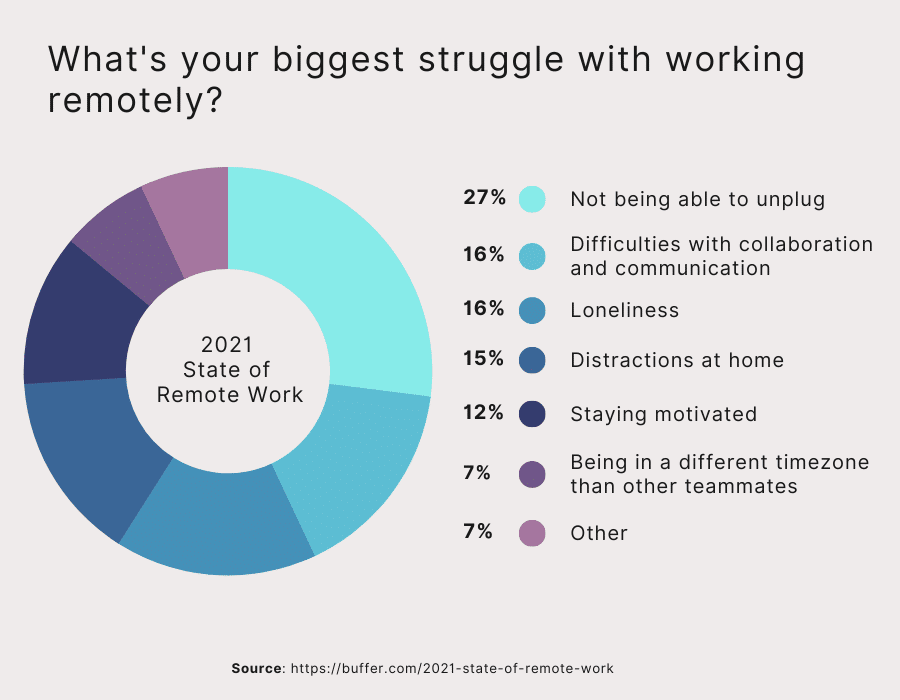
When we think of remote work, many of us think of meetings in our sweatpants, the ability to schedule appointments when we want and not having to sit in traffic for hours. For many, a remote or hybrid schedule is like a dream come true. We’ve looked at the variety of benefits in past articles, among them: work/life balance, increase in productivity, no commute, increased flexibility and autonomy and so much more. And we’ve looked at why offering a remote and/or hybrid schedule is an incredibly effective recruiting and retention tool. But even with all the positives, remote work can present a whole new set of challenges for some employees. Let’s take a look at some of the top 5 remote work complaints:

Con #1: Social isolation

This is probably the number one complaint that employees have about remote work, particularly new workers and young workers who are new in their career. It may be challenging to build strong relationships with colleagues without face-to-face communication, resulting in a sense of disconnection from the team. Social events like happy hours that were once spur of the moment and easy to plan, now take more effort and can end up on the backburner.

Con #2: Work-life boundaries are blurred

While some feel one of the biggest benefits of remote work is work/life balance, others have difficulty unplugging from the office and feeling like they’re always “on call”. It can be difficult to disconnect from work and take breaks when workspace is also a private space. This lack of separation can negatively impact mental well-being if not managed effectively and can lead to burnout.

Con #3: Communication and collaboration are limited

Zoom meetings are all well and good, but some aspects of face-to-face interaction can’t be done remotely. Remote work can make it challenging to build trust through in-person interactions. Some team members may also feel like their access to mentorship, networking and senior leadership opportunities are more limited.

Con #4: Risk of miscommunication

Remote work often involves written communication, which can sometimes lead to misunderstandings or misinterpretations. It may be challenging for remote workers to resolve conflicts effectively without the benefit of immediate in-person conversations.

Con #5: Lack of focus and distractions

While the typical distractions of the workplace may be eliminated, remote work introduces a new set of distractions at home. It’s easy to be distracted from work tasks by household chores, family members or other personal issues. Some workers may not have the space to exclusively dedicate to a home workplace and have to work in busier areas.

Each of us has a unique personality and work style. For every person who enjoys the solitude of working remotely and the freedom that it provides, there’s another who thrives on human interaction or craves the routine and structure of going into the office. That’s why management plays such an important role in implementing a strategic remote/hybrid work strategy and communicating it effectively with team members. Leah M Joppy and Associates is ready to help you reduce the cons of remote work and ensure that team members feel supported and engaged.

Contact us at 301-670-0051 or email us at leah@lmja.com to learn more and get started.

Share
Categories
Uncategorized

Listening To The Workforce: How To Make Remote Work Successful

There are so many reasons to love remote and hybrid work. For some, it’s rolling out of bed and starting the work day without the hassle of a long, stressful commute. For others, it’s the flexibility of picking up their kids from school or throwing in a load of laundry during lunchtime. Whatever the appeal, remote and hybrid work models are here to stay. Organization must embrace it if they want to remain competitive and recruit new team members. And the numbers back this up:

  • According to job site ZipRecuiter, jobs specified as “remote” receive 300% more applications than jobs that are not.
  • Organizations that don’t offer any kind of flexible-work options could be losing out on up to 70% of job seekers, according to HR consulting firm Thrive HR.
  • Nearly half (45 percent) of government employees will consider looking for a new job if their agency reduces remote and hybrid work flexibility, according to Eagle Hill Consulting research. These findings come on the heels of new federal government guidance that calls for a substantial increase in in-person work, along with unprecedented challenges filling government jobs.

Offering remote/hybrid positions is one thing, but execution is quite another. Once you have new team members in the door, it’s essential that managers know how to lead remote and hybrid workers. No one wants to feel like they’re out of the loop and continuous frustration with communication, technology and overall job satisfaction can lead to turnover. That’s why strong, well-trained leaders are key to the entire process.

When it comes to managing a remote/hybrid team, let’s start with a few of the basics. We’ve outlined a few “dos and don’ts” below. Maybe you’re already using most of them or perhaps they’re a good reminder of where you need to improve:

  • Do set immediate and clear expectations. And make sure they’re communicated clearly to everyone.
  • Do schedule regular team meetings and make them a priority (no regular cancellations!).
  • Do provide necessary resources. Leaders must ensure team members have the technology and other tools they need to succeed in a remote and/or hybrid environment.
  • Do engage directly with employees as often as possible. Have an open-door policy and set aside time for one-on-one conversations
  • Don’t just have a communication strategy in place, document it and share it. Everyone needs to be on the same page.
  • Don’t just encourage feedback, make it a priority. Really take the time to listen to team members.
  • Don’t micromanage and make employees feel like they’re not trusted.

Remote and hybrid work schedules only continue to grow in popularity and can be a major recruiting tool when trying to attract new team members. But implementation needs to be done correctly in order to retain workers. Leah M Joppy and Associates can help you figure out your primary challenges and work with you and your team to make remote/hybrid working a more efficient, productive and fun experience! Call us at 301-670-0051 or email us at leah@lmja.com to learn more.

Share
Categories
Uncategorized

Is There A Future In Remote Work?

Looking ahead, the future of remote work seems to only be increasing and flourishing. According to Upwork, by 2025, an estimated 32.6 million Americans will be working remotely, which is about 22% of the workforce. This projection suggests a continuous, yet gradual, shift towards remote work arrangements.

For many organizations, flexibility is a new part of their compensation package and is a powerful tool in terms of employee engagement, retention and recruiting. Remote and flexible schedules not only provide employees with job satisfaction, but better health, increased work-life balance and less stress.

How does the federal government stack up in terms of remote and hybrid work? According to an annual government-wide survey conducted by the Office of Personnel Management,

more than two-thirds of federal employees are still teleworking at least occasionally. About one-third of the over 625,000 people surveyed said they do not telework at all, due to technological limitations, in-office requirements or personal choice. The remainder, about 68%, telework at least occasionally and most people said they telework three to four days per week.

Even as calls for in-person work have pushed leaders to reconsider remote work policies, they seem reluctant to do so. Remote and hybrid work benefits employers through higher productivity levels, decreased turnover and reduced absenteeism. And as we saw in our previous article, remote and hybrid positions equal more job applicants. Here are a few other ways that it benefits government agencies:

  • Ease with recruiting: Public sector recruitment isn’t always easy. Sometimes salaries are less competitive than the private sector, causing many potential hires to consider working for businesses instead. In offering a fully-remote or hybrid work structure, government agencies can increase the odds of finding an ideal candidate.
  • Casting a wider hiring net: With work from anywhere a reality, organizations can hire candidates anywhere in the world who will have the skills and qualifications needed, even if they don’t live there. The best may not live within driving distance of the office, but that shouldn’t be a barrier to employment.
  • Increasing diversity in the workplace: Studies have shown that groups, including women, people of color and those with disabilities, view remote work positively. Allowing staff to work from anywhere instantly increases the diversity of your candidate pool and removes obstacles to employment such as lack of transportation.

Recruitment and retention in today’s competitive hiring landscape can be a challenge. A strong remote and hybrid workplace can be just the tool your organization needs to attract a larger pool of qualified candidates. Leah M Joppy and Associates can help you create an effective recruitment strategy that outlines your remote workplace model and why potential new hires should work for you! Contact us at 301-670-0051 or email us at leah@lmja.com to learn more and get started.


Share
Categories
Uncategorized

The Government and Artificial Intelligence

Conversations about Artificial Intelligence (AI) have been going on everywhere over the past year. The capabilities of ChatGPT, the generative AI chatbot developed by OpenAI, have gone viral across social media and we’ve marveled as it answered complex questions in seconds with shocking accuracy. But as AI has seemingly blown up and commanded our attention, it also poses as many questions as it answers. How will it impact the future of the workplace? And what will jobs look like moving forward?

A new report from Fedscoop.com, “Gauging the Impact of Generative AI on Government,” surveyed 200 government program and operations executives, as well as IT and security officials. The report identified the major issues and concerns executives face as they consider adopting generative AI in their agencies. It found that three-fourths of the leaders polled said that their agencies have already begun establishing teams to assess the impact of generative AI and are planning to implement initial applications in the months ahead. And according to a new database uploaded to the AI.gov website, the government recently disclosed more than 700 artificial intelligence use cases among federal agencies.

Let’s take a closer look at some of the numbers from this survey, as they provide interesting insight into how agency leaders view the future of AI:

  • Survey respondents feel generative AI will provide major opportunities for employees. The top opportunities include:
    • Ability to give employees added technical support (eg: a co-pilot): 65%
    • Ability to reduce the time required to complete work processes: 64%
    • Ability to free up employee tasks to produce more valuable work: 63%
  • Nearly half of the agency business executives polled expect one or more generative AI applications will be rolled out in the next 6-12 months for data analytics, IT development/cybersecurity and business operations. IT executives are more confident in the timeline: roughly two-thirds believe it will happen within the next 6-12 months.
  • A significant percentage of leaders (71%) believe that the potential advantages of using generative AI in their agency’s operations outweigh the perceived risks.
  • Half of all executives polled (and 64% of those at defense and intelligence agencies) cited a lack of employee training to use generative AI responsibly as a top concern. However, only 32% noted the need to develop employee training programs as a critical employee concern. This suggests a big disconnect in how agency leaders view AI training.

We’re all at the beginning of a journey to understand generative AI’s power and capabilities. Research suggests that this new era of AI will transform roles and increase performance across areas such as customer interactions, data analysis and software development. However, the roll-out and implementation of AI is only as good as the communication by leaders and the training of workers. Most of all, it calls for careful planning. Call us at 301-670-0051 or email us at leah@lmja.com for more information.

Share
Categories
Uncategorized

The Pros and Cons of AI in the Workplace

Generative artificial intelligence (AI) has become a polarizing topic in recent months. The rapid evolution of ChatGPT and its capabilities have captured the world’s attention and have prompted questions about its impact on our lives, particularly our work lives. As with all new waves of technological advances, there are concerns: “Will AI replace my job?” “What are the ethical considerations?” “How do I even begin to learn about this stuff?”

As we saw in our article above, agencies are generally in favor of adopting AI in the workplace and some implementation has already started (or is on the horizon). While change can be challenging, it’s on the way, whether we’re ready or not. Now’s the time to start looking at the pros and cons of AI in the workplace and having discussions about how it could impact our work lives moving forward. Some of the top pros and cons are outlined below:

AI Pros in the Workplace

  • Increased Efficiency: AI can automate many routine tasks, freeing up workers to focus on higher-level projects and increase productivity.
  • Enhanced Decision-Making: AI can analyze data and offer insights that people may not be able to identify, leading to better decision-making and effective strategies.
  • Cost Savings: By automating tasks, AI can reduce labor costs and improve the bottom line for organizations.
  • Enhanced Customer Experience: AI-powered chatbots and other tools can provide fast, personalized service to clients, improving their overall experience.

AI Cons in the Workplace

  • Job Displacement and Challenges in the Workforce: This is probably the biggest one. As AI automates routine tasks, there is a concern that certain job roles may become obsolete, leading to unemployment. The need to reskill employees to adapt to changes brought by AI poses a number of challenges for workers and organizations.
  • Ethical Considerations: AI raises ethical concerns regarding data privacy, bias and transparency. Organizations must be proactive in addressing these concerns and establish ethical guidelines to prevent misuse or unintended consequences.
  • Lack of Training and Poor Implementation: Implementing AI requires major investments in infrastructure, training and integration with existing systems. Cutting corners in areas like training as a way to save money results in misuse or not using AI to its fullest potential.
  • Lack of Emotional Intelligence: While AI is great at data analysis and automation, it lacks the human touch needed for certain tasks. Industries relying heavily on human interaction may find it challenging to replace human expertise with AI systems.
  • Accuracy: AI has developed at a rapid pace and it still has a way to go to offer up-to-date information. Tools such as ChatGPT base decisions on the past and it’s been argued that it can be behind with it comes to accurate facts and updates. It’s still important to do your own research to ensure the information is correct.

As agencies start to integrate generative AI into their operations, understanding opportunities and concerns becomes crucial for preparing to transition into this AI-driven era of government. Most of all, it calls for careful planning. Call us at 301-670-0051 or email us at leah@lmja.com for more information.

Share
Categories
Uncategorized

Social Media Content: Career Advice For The Younger Generation?

Whether you love or hate social media or choose to not participate altogether, there’s no question it has a profound influence on younger generations. It’s a part of life for Gen Z and doesn’t just affect their buying habits and pop culture tastes. It’s also where they often turn for career advice.

In October 2023, ResumeBuilder.com surveyed 1,000 full-time workers aged 21 to 40 regarding how TikTok has influenced their career decisions. The numbers speak for themselves. No surprise here: Gen Zers are more likely to make decisions based on TikTok creators. The survey revealed about 41% of those who use TikTok have made career decisions based on information they’ve seen on the app. At least 88% of people who took TikTok advice said it had a positive impact on their lives, 10% said it was neutral and just 2% said those decisions worked out negatively.

Last month, we looked at several TikTok employment trends that gained popularity last year, including “Quiet Quitting”, “Lazy Girl Jobs” and “Bare Minimum Mondays”. All three involved Gen Z’s quest for work/life balance, setting boundaries and sticking to their job description. Here are two other big employment trends that organizations should be aware of as they look to attract and retain the next generation of workers:

  • “Managing Up”: This is by no means a new concept, but it took TikTok by storm last year. The hashtag #managingup currently has 5.5 million views and career advisors on the platform are promoting it as a key to making your job suit your needs. “Managing up” is understanding your manager’s working style and adjusting your own approach to make both your day-to-day jobs easier. Essentially, it’s about creating, maintaining and improving a working relationship with your boss.
  • “Boreout”: What do you do when you realize your dream job isn’t all it’s cracked up to be? For Gen Z, it’s airing your frustrations on platforms like TikTok. The hashtag #boredatwork had about 470 million views as Gen Zers shared the mundane and repetitive aspects of their job. This disenchantment is often called “boreout” and can be equally as harmful as burnout. Lack of stimulation in a role can lead to negative feelings about an organization and higher rates of turnover.

Keeping up with social media employment trends can seem like an impossible task, particularly when they seem to change by the day. But when it comes to what Gen Z is looking for in the workplace, the message is pretty clear: work/life balance is key, meaningful work is important and flexible schedules are in demand. How can your organization attract and retain Gen Z workers? It’s one of the top questions Leah M Joppy and Associates receives from clients.

While LMJA realizes the federal sector has little flexibility in hiring practices, we have been very successful with helping our federal customers make minor tweaks in the interview process that can increase the chances of selecting a successful candidate that will stay around awhile! We’re ready to improve your 2024 recruitment strategies with tactics that will help you understand this younger generation and what they really want in the workplace.

Want to learn more? Call us at 301-670-0051 or email us at leah@lmja.com.

Share

How Can We Help?

Leah M. Joppy & Associates

Derwood, MD 20855